

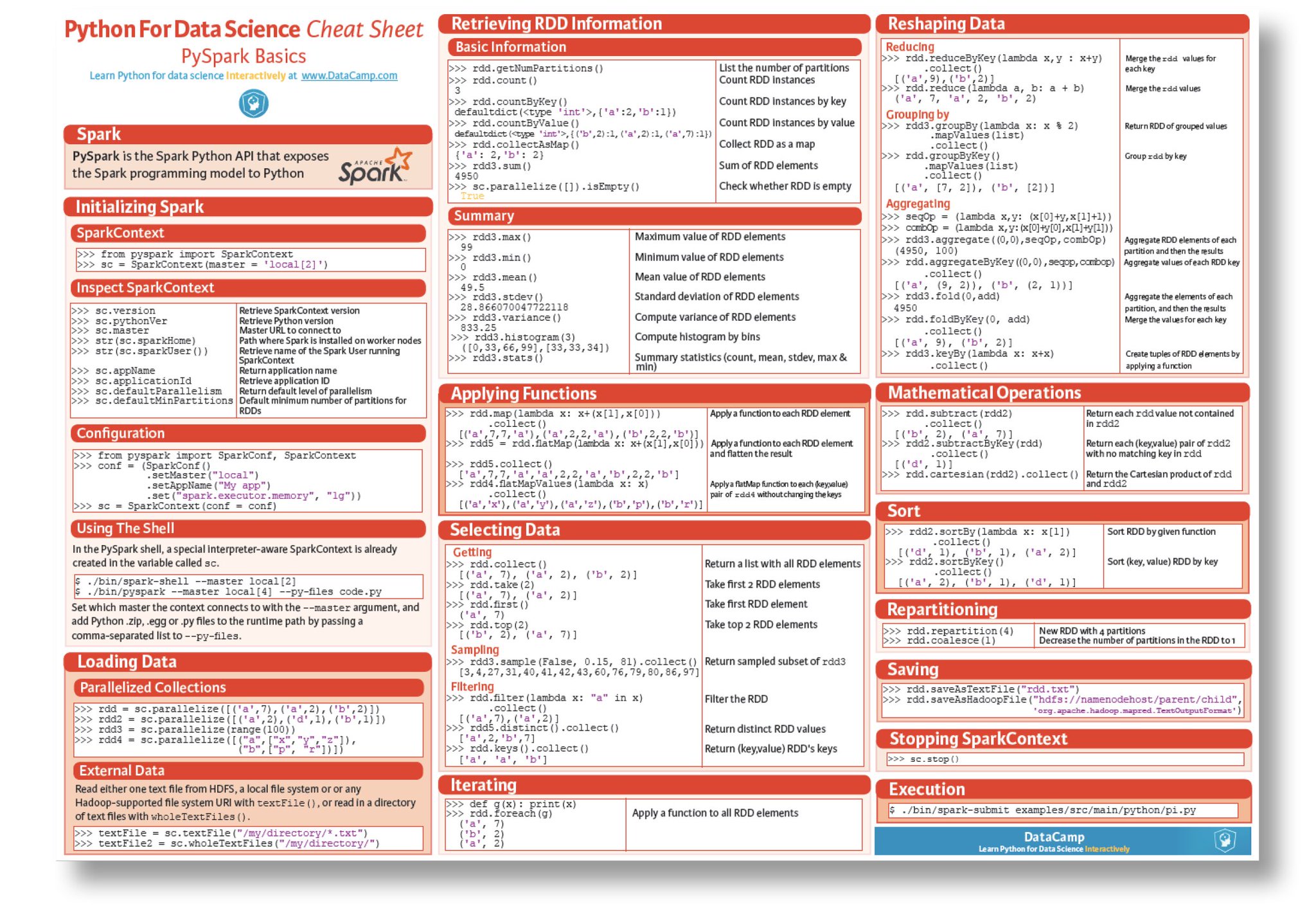
I've found DataCamp, whose cheat sheets comprise a large portion of the above links, to provide very clear explanations and am currently enjoying their Python Data Science courses. Steve Testa. 2. The cheat sheet is clean and presents you with all of the different methods for getting what you want out of Python! Pro Tip: This is one you should definitely keep laminated and tapped to the desk! The short hands are amazing and come in handy when you know you need one but do not remember quite how to write it out.
Welcome to Python Cheatsheet!¶ Welcome to pysheeet. This project aims at collecting useful Python snippets in order to enhance pythoneers’ coding experiences. Please feel free to contribute if you have any awesome ideas for improvements to code snippets, explanations, etc. Any snippets are welcome.
Data Science is rapidly becoming a vital discipline for all types of businesses. An ability to extract insight and meaning from a large pile of data is a skill set worth its weight in gold. Due to its versatility and ease of use, Python has become the programming language of choice for data scientists.
In this Python cheat sheet, we will walk you through a couple of examples using two of the most used data types: the list and the Pandas DataFrame. The list is self-explanatory; it’s a collection of values set in a one-dimensional array. A Pandas DataFrame is just like a tabular spreadsheet, it has data laid out in columns and rows.
Let’s take a look at a few neat things we can do with lists and DataFrames in Python!
Get the pdf here.
Python Cheat Sheet
Lists
Creating Lists
Create an empty list and use a for loop to append new values.
#add two to each value
my_list = []
for x in range(1,11):
my_list.append(x+2)
We can also do this in one step using list comprehensions:
my_list = [x + 2 for x in range(1,11)]
Creating Lists with Conditionals
As above, we will create a list, but now we will only add 2 to the value if it is even.
#add two, but only if x is even
my_list = []
for x in range(1,11):
if x % 2 0:
my_list.append(x+2)
else:
my_list.append(x)
Using a list comp:
my_list = [x+2 if x % 2 0 else x
for x in range(1,11)]
Selecting Elements and Basic Stats
Select elements by index.
#get the first/last element
first_ele = my_list[0]
last_ele = my_list[-1]
Some basic stats on lists:
#get max/min/mean value
biggest_val = max(my_list)
smallest_val = min(my_list)avg_val = sum(my_list) / len(my_list)
DataFrames

Reading in Data to a DataFrame
We first need to import the pandas module.
import pandas as pd
Then we can read in data from csv or xlsx files:
df_from_csv = pd.read_csv(‘path/to/my_file.csv’,
sep=’,’,
nrows=10)
xlsx = pd.ExcelFile(‘path/to/excel_file.xlsx’)
df_from_xlsx = pd.read_excel(xlsx, ‘Sheet1’)
Slicing DataFrames
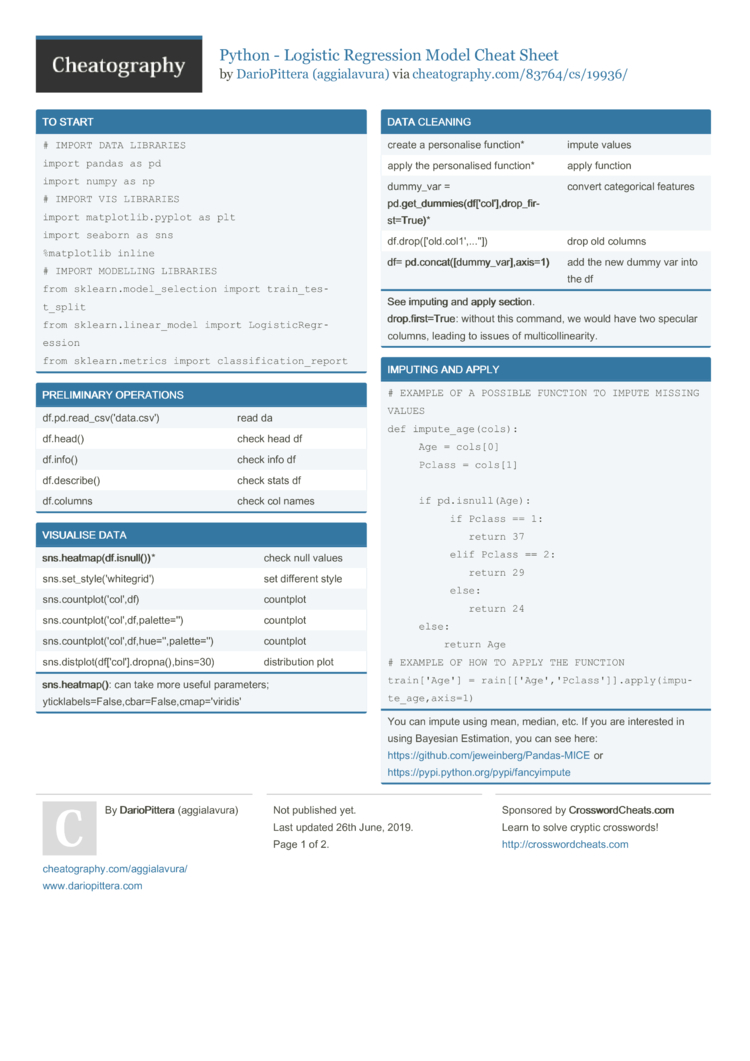
We can slice our DataFrame using conditionals.
df_filter = df[df[‘population’] > 1000000]
df_france = df[df[‘country’] ‘France’]
Python Data Cleaning Cheat Sheet Pdf
Sorting values by a column:
df.sort_values(by=’population’,
ascending=False)
Filling Missing Values
Let’s fill in any missing values with that column’s average value.
Python Data Cleaning Cheat Sheet Excel
df[‘population’] = df[‘population’].fillna(
value=df[‘population’].mean()
)
Applying Functions to Columns
Apply a custom function to every value in one of the DataFrame’s columns.
Python Data Cleaning Cheat Sheet Examples
def fix_zipcode(x):
”’
make sure that zipcodes all have leading zeros
”’
return str(x).zfill(5)
df[‘clean_zip’] = df[‘zip code’].apply(fix_zipcode)